
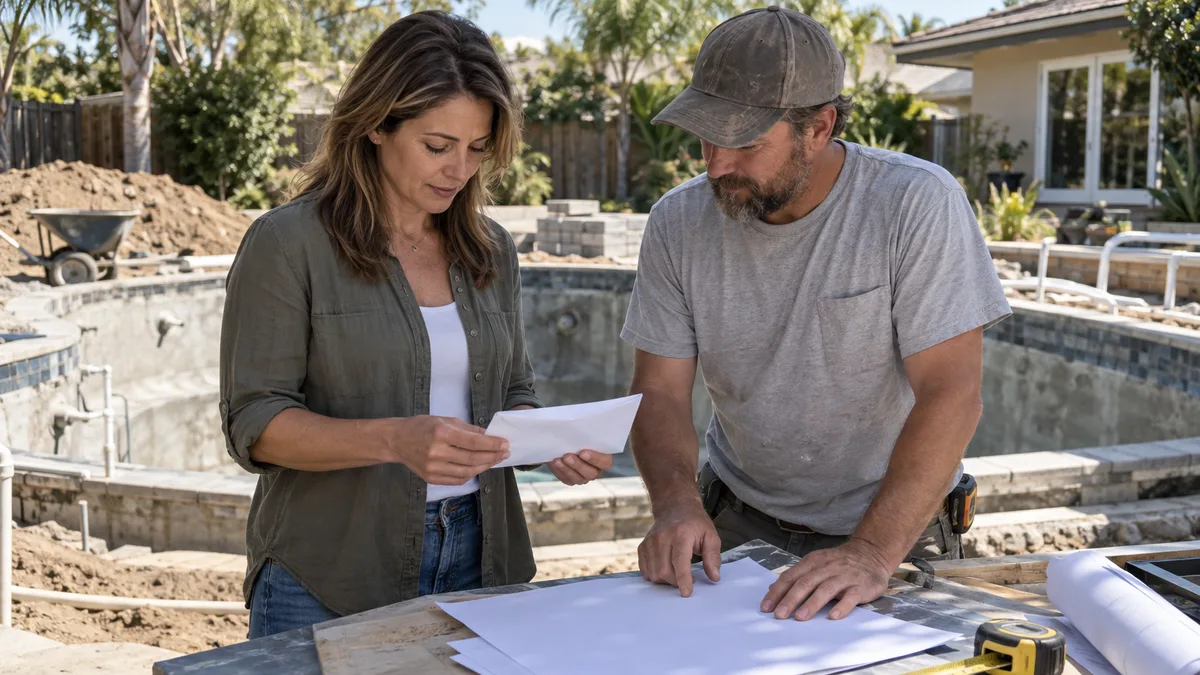
For most California pool contracts, your pool builder’s deposit is limited to the lesser of $1,000 or 10% of the contract price, according to the California Contractors State License Board (CSLB). This is a legal ceiling, not a published typical deposit amount. A narrow exception applies to contractors with qualifying blanket performance and payment bonds on file.
After the down payment, each progress payment should correspond to specified work or materials, and payments cannot exceed the value of work completed. For example, requesting payment for gunite before that work is finished is front-loading, which the board warns is illegal. Before paying, compare each request with the contract milestone and the work or materials actually supplied.
Key Takeaways
- For California pool work costing more than $500 in labor and materials, confirm your written contract includes a scale drawing and clearly defined payment triggers.
- For an in-ground pool in Los Angeles, allow time for LADBS plan review because permits are not issued the same day.
- Request an itemized pool estimate that identifies excavation, pool structure, equipment, decking, coping, and fencing so you can compare invoices with completed work.
- Before paying for pool construction or repair costing $1,000 or more, verify the contractor’s license and swimming-pool classification in state records.
How Much Is a Pool Builder Deposit?
For a California pool contract, your down payment is limited to the lesser of $1,000 or 10% of the contract price. The limit is a legal ceiling, not a published standard or typical deposit amount.
To apply the cap, compare $1,000 with 10% of the contract price and use the lower figure. The project’s price and scope affect the calculation because they determine the contract price. A broader or more limited scope can change that price. Finance charges are excluded from the calculation.
The California Contractors State License Board (CSLB) says special-order materials do not raise the down-payment limit. A contractor cannot request a larger down payment simply because materials must be ordered for your project.
Don’t confuse the down payment with later progress payments. Those are separate contract payments tied to work or materials during construction.
How Should Pool Construction Payments Work?
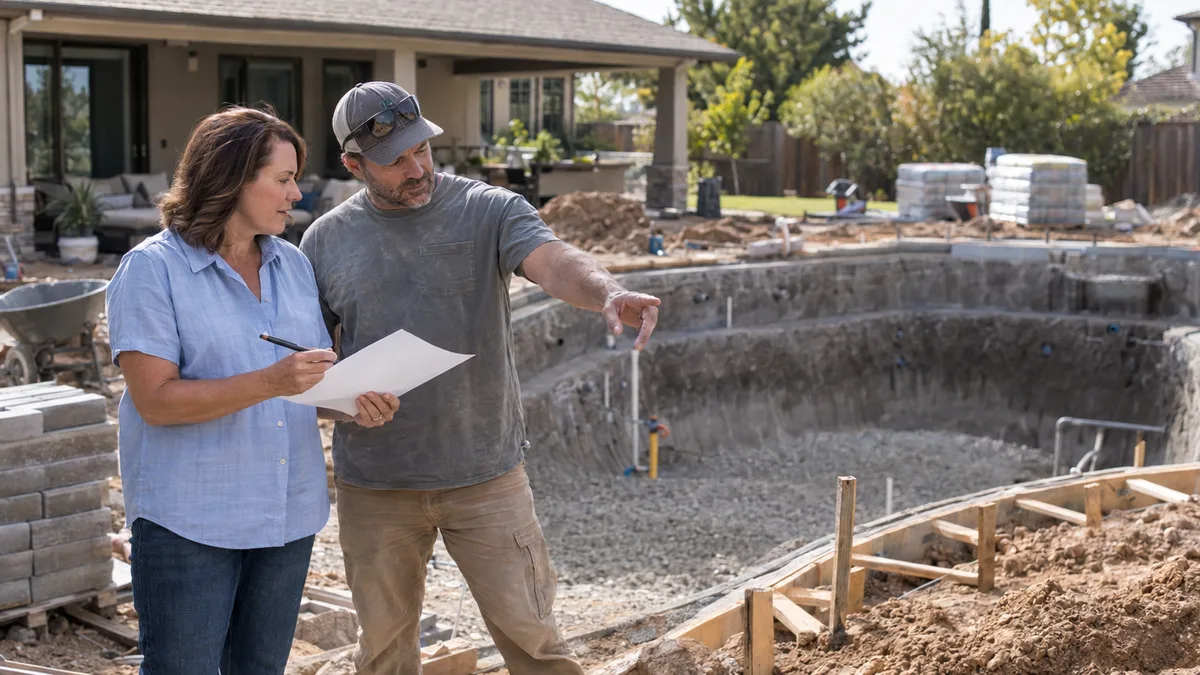
Your pool construction payments should follow a contract schedule that ties each amount to specified work, materials, or services. Payments should not exceed the value already delivered. Review the schedule before approving an invoice so you know what each milestone covers.
A payment request should match completed work or supplied materials, not work planned for a later stage. The California Contractors State License Board (CSLB) warns that front-loading pool construction payments is illegal. For example, a builder should not request payment for gunite before the gunite work is complete.
Compare every invoice with the contract’s milestone description. If an invoice covers both labor and materials, check that the listed work is finished and the materials have been supplied. Ask for clarification if the invoice does not identify the covered work or materials, or if the amount appears ahead of progress.
Keep your contract, invoices, receipts, and payment confirmations together. Use a traceable payment method so you can document the amount, date, and recipient of each payment. These records make it easier to track the balance against the schedule and resolve questions about what a payment covered.
For a pool contract, you may make the final payment when the final plastering phase is complete, provided contract-required equipment, decking, and fencing are also complete. Check your contract for those items before making the final payment, and keep confirmation of the transaction with your project records.
What Must Your Pool Contract Spell Out?
Your pool contract must be written when combined labor and materials cost more than $500. It should clearly describe the project, payment terms, start-date notice, and cancellation rights.
Your pool contract should include a homeowner checklist and a scale drawing. Check that the drawing identifies the pool’s shape and dimensions, describes its construction, and specifies the equipment. These documents help you compare the agreed project with the work described in the contract.
The contract must also state that, without lawful excuse, failure to substantially commence work within 20 days of the stated start date violates Contractors License Law. Make sure you can find the stated start date and understand what work the contract includes.
Read the payment and cancellation terms in plain language before signing. Your contract should make clear:
- the deposit amount;
- each later payment and the work, materials, or services that trigger it;
- what work and materials are included; and
- how and when you can cancel.
If your pool contract was solicited somewhere other than the contractor’s place of business, you generally have three business days to cancel, and the cancellation must be in writing. Review the cancellation terms before signing so you know how to exercise that right. If a payment trigger or included item is unclear, ask for a clear explanation and written clarification before agreeing to the contract.
How Do Permits Affect Payment Timing?
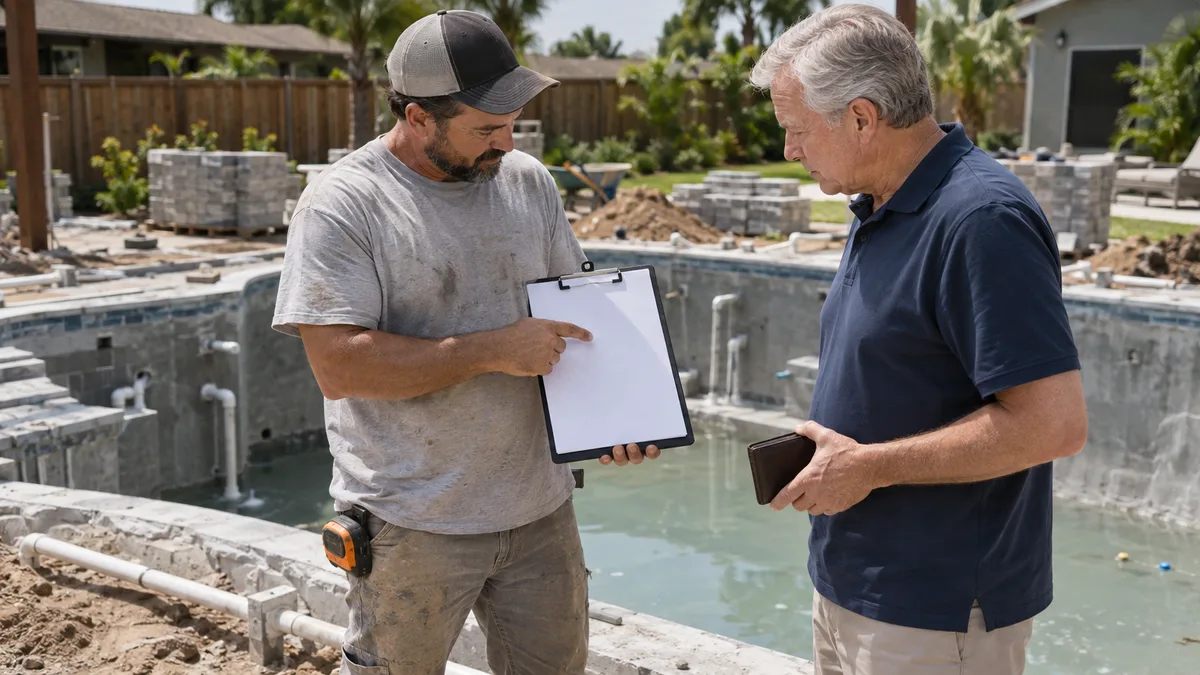
Permits can extend your preconstruction schedule, but permitting is separate from the deposit limit and does not justify an undefined upfront payment.
For in-ground pools and spas in the City of Los Angeles, the Los Angeles Department of Building and Safety (LADBS) requires plan review, including review of safety-barrier requirements, and does not issue permits the same day. Your contract should identify who handles permitting, related costs, and any payment milestone tied to specific permitting services or work.
All County Pools and Spa Inc. handles city permitting for residential and commercial pool projects. Its stated project sequence shows how the steps may fit together:
- Consultation: Discuss your project and outdoor space so the design process can begin.
- Design: Develop the pool plan and project details that will inform permit review.
- Permitting: Submit plans for required review and allow time for the city’s process before construction starts.
- Construction: Complete the contracted work. Your contract should describe site preparation and connect any related payment to specific work or services.
- Final walkthrough: Review the finished project at the end of the construction sequence.
What Should a Pool Estimate Include?
Your pool estimate should itemize the included work and materials so you can compare the contract price with the project scope. Look for separate descriptions of excavation, pool structure, equipment, decking, coping, and fencing, along with any specified outdoor features. Equipment details should identify what your project includes, such as pumps and filtration systems.
All County Pools and Spa Inc. provides free on-site estimates and itemized project estimates. The company describes its custom pool construction as gunite over a tied rebar cage. An estimate may also cover features beyond the pool itself, such as a plunge pool, spa, waterfall, patio cover, cabana, outdoor kitchen, or sport court.
Custom features or a broader backyard transformation can change the scope of work. Itemization gives you a clearer way to compare a progress-payment request with completed work or supplied materials, and to distinguish included work from a proposed addition.
If you want to revise the design or add a feature, request a written change order before authorizing the change. It should spell out the added or revised work, associated costs, and any schedule implications. For example, an outdoor kitchen should be described as a specific scope change, not left as a verbal understanding or folded into an unexplained total.
Spot Deposit Red Flags Before Paying
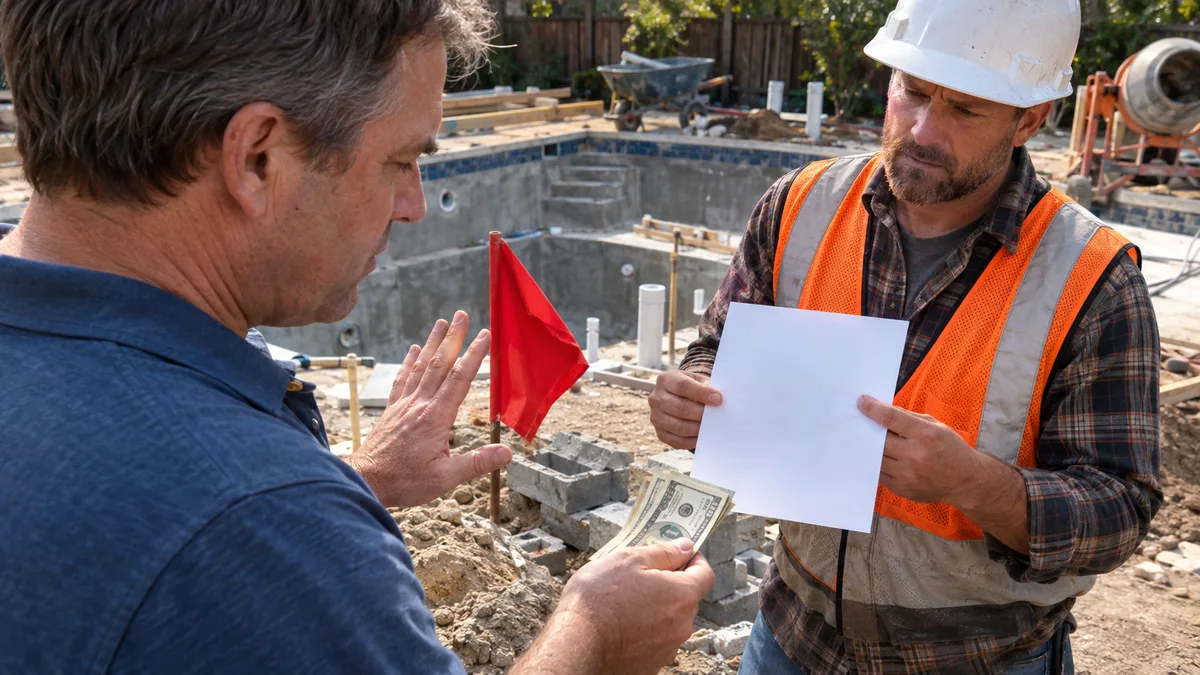
For pool construction or repair costing $1,000 or more, California requires a currently licensed contractor in the appropriate classification, including a swimming-pool contractor. Verify the contractor’s license status and classification in state license records before paying.
Treat a questionable request as a reason to pause and clarify, not as automatic proof of wrongdoing. Watch for requests to:
- Pay the full contract price before the work is done.
- Pay for unfinished work or materials that have not been supplied.
- Approve a payment tied to a vague milestone, such as “construction progress,” without a clear description of what it covers.
- Pay immediately under pressure, without time to compare the request with the signed contract.
- Make a payment without a receipt or other written confirmation.
Ask the contractor to explain the request in writing and identify the contract term or completed work that supports it. For example, if an invoice says “pool construction” without specifying a completed phase, ask what work the amount covers and how the milestone is defined in your signed agreement.
Before sending money, confirm that the requested amount and timing match your signed contract and applicable California rules. Keep the receipt or payment confirmation with your contract and invoices so your records show who received the payment, how much was paid, and when.
Review the Deposit Before You Sign
Before signing, review the exact contract version you plan to accept. Note the total contract price, requested deposit, due date, and any written explanation of an exception. If the estimate, contract, and payment request show different amounts, ask for corrected paperwork before sending money.
Check that the deposit applies to the scope you intend to approve. For example, if a proposal covers both a pool and other backyard work, make sure the contract clarifies whether the deposit is calculated against the full project or a separately priced portion. Mark unclear wording, blank fields, and references to missing attachments, then request a complete copy that includes any agreed revisions.
If you manage a property, confirm that the owner or authorized representative has reviewed the final terms before signing. Keep the signed contract and its attachments together so you can easily find the approved amount and scope later.
All County Pools and Spa Inc. serves Tarzana and communities across Greater Los Angeles. Contact All County Pools and Spa Inc. at (818) 720-3316 to discuss your pool or backyard project.
Frequently Asked Questions
1. Is a pool builder deposit refundable if I cancel?
Whether your pool builder deposit is refundable depends on the contract, the reason for cancellation, and any cancellation rights that apply. Before paying, ask for the refund terms in writing, including how the builder will handle any design or other work already completed.
2. Can I negotiate a smaller pool builder deposit?
Yes, you can ask the pool builder to accept a smaller deposit. If you agree on a different amount, make sure the signed contract and payment schedule clearly show it.
3. Can pool financing be used to pay a builder deposit?
You can use pool financing for a builder deposit if your lender’s terms allow it and the funds are available when payment is due. Confirm the permitted use and disbursement timing with your lender, then coordinate the payment date with the builder.
4. Does a pool builder deposit cover design work as well as construction?
Your pool builder deposit does not, by itself, clarify whether design work is included. Ask the builder to identify the design deliverables and explain in writing whether their cost is included in the project price or billed separately.