
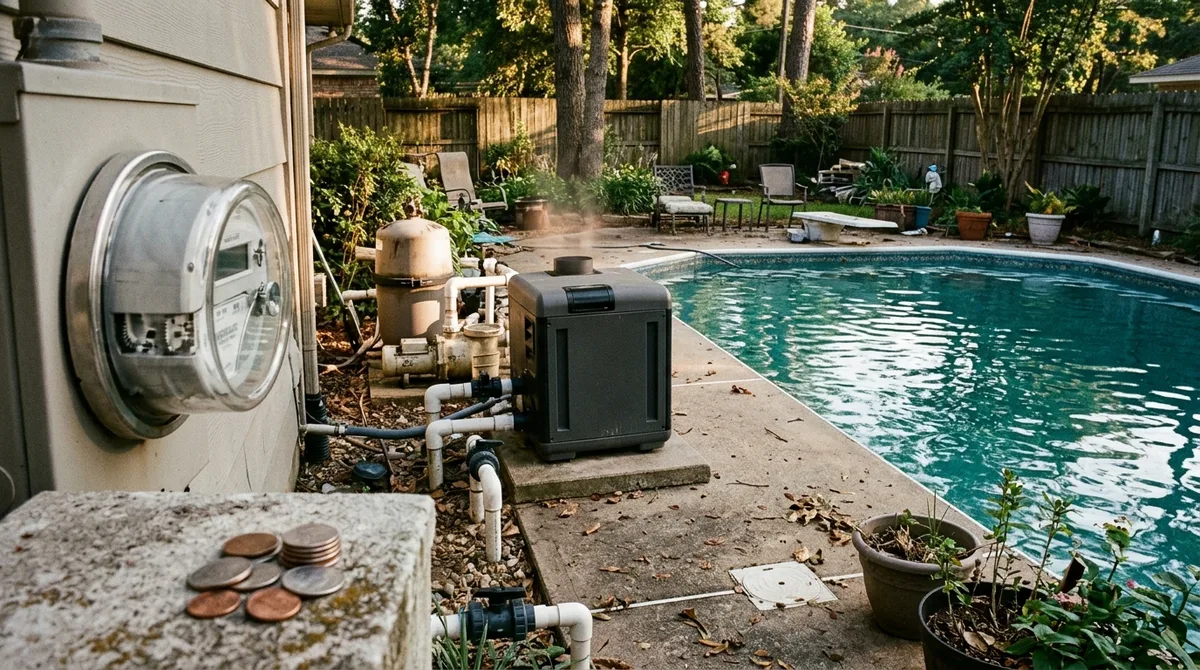
Monthly pool-heater costs can vary widely, but published estimates offer a useful starting point: heat pumps are commonly budgeted at $50–$150 per month, natural-gas heaters at $200–$500, and propane heaters at $250–$1,000. HomeGuide’s cost guide presents these as indicative operating ranges, not guaranteed bills. Your actual costs depend on pool size, weather, target temperature, cover use, runtime, heater efficiency, and local energy prices.
Local rates can significantly affect the comparison. The U.S. Energy Information Administration reports that 2025 residential electricity averaged 17.23¢ per kilowatt-hour nationally, compared with 31.35¢ in California and 11.83¢ in Idaho. These state data help explain why running the same heater can cost more in one location than another. The useful question is not just which heater has the lowest estimated range, but what it may cost to maintain your preferred water temperature during your swimming season.
Key Takeaways
- Published monthly operating-cost benchmarks are $50–$150 for heat pumps, $200–$500 for natural-gas heaters, and $250–$1,000 for propane heaters, but actual bills depend on pool conditions, heater use, efficiency, and local energy prices.
- Local energy prices can change the comparison substantially: 2025 residential electricity averaged 17.23¢ per kilowatt-hour nationally, 31.35¢ in California, and 11.83¢ in Idaho.
- A fair heater-cost estimate uses the same pool volume, target temperature, weather, cover use, heating schedule, and local energy rates for each option; one modeled 30-day example estimated $146 for a heat pump and $437 for a gas heater under its stated assumptions.
- A pool cover can save up to 50–70% of overall pool-heater energy use, although actual savings depend on pool conditions and consistent cover use.
What Does a Pool Heater Cost Per Month?
Monthly pool-heating costs vary considerably. Published ranges are planning benchmarks, not guaranteed bills. The annual estimates behind those ranges assume an eight-month swimming season, so they should not be treated as a flat monthly charge throughout the year.
A calculator can provide a more specific comparison. For a 16-by-32-foot pool averaging 5 feet deep, the model uses a month with a 15°F initial heat-up and 3°F of daily heat loss. At electricity prices of $0.173 per kilowatt-hour and gas prices of $2.55 per therm, it estimates $146 for a heat pump operating at a COP of 5.0 and $437 for a gas heater at 84% efficiency. PoolStops’ modeled example shows how defined assumptions produce a monthly estimate. It is not a prediction for every pool of that size.
Published benchmarks and modeled estimates cannot predict an individual bill. Pool conditions, local energy rates, and how you use the heater determine your actual costs.
Why Do Monthly Costs Vary?
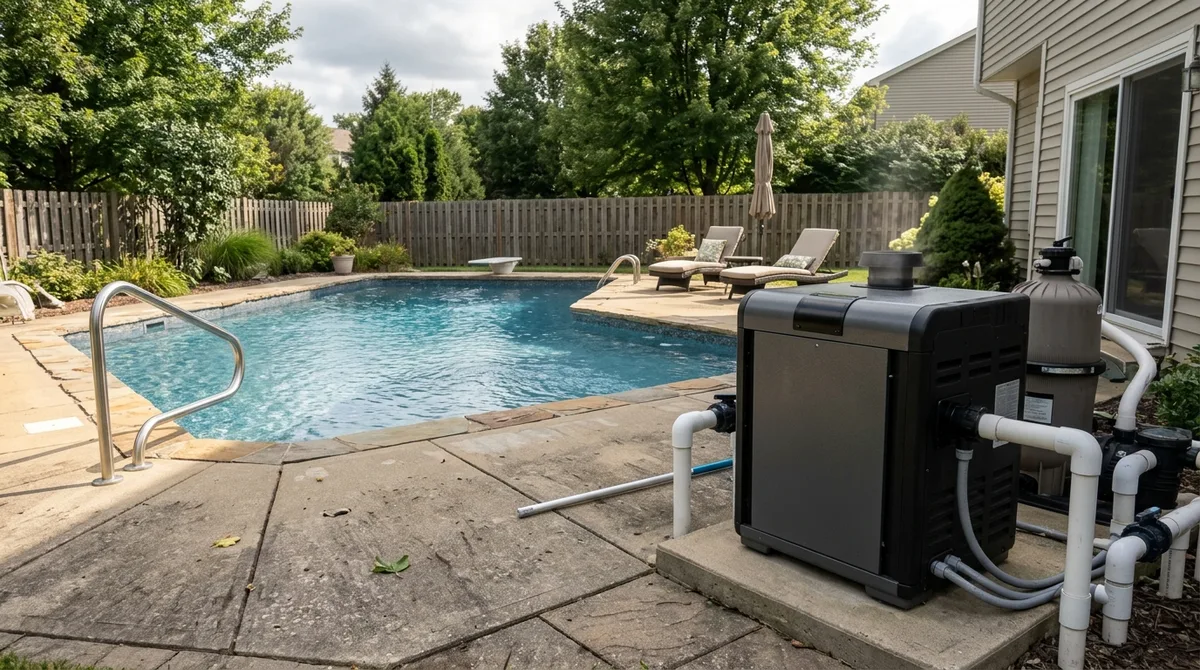
Monthly pool-heating bills vary with water volume, desired temperature, heat loss, heater runtime, equipment efficiency, and local energy prices. A larger pool generally takes more energy to heat because it contains more water. The starting and target temperatures also matter: raising cooler water to a higher temperature requires more heat.
Outdoor conditions affect both heat-up time and ongoing energy use. Colder air and wind can increase heat loss, requiring the heater to run more often to maintain the set temperature. A pool that loses heat quickly also needs more energy than one that retains warmth. A cover can limit heat loss and save up to 50–70% of overall pool-heater energy use.
Outdoor conditions during your swimming season can differ, affecting heat-pump performance.
Local electricity prices can make the same heating demand cost more in one place than another. The 2025 residential electricity averages were 17.23¢ per kilowatt-hour nationally, 31.35¢ in California, and 11.83¢ in Idaho. Fuel prices also vary by location, so compare the rates that apply to the heater you are considering rather than relying on a national average.
When comparing monthly estimates, use your utility’s current electricity or fuel rate, your pool’s volume, and the temperatures you expect to maintain. Account for your likely swimming season and the outdoor conditions during those months. A short season in warm weather can produce a different operating pattern from a longer season with colder conditions.
How Do Heat Pumps Compare With Gas?
Heat pumps are generally budgeted at $50–$150 per month, compared with $200–$500 for natural gas and $250–$1,000 for propane. These are planning benchmarks, not guaranteed bills. Actual costs depend on energy rates, pool conditions, and how you use the heater.
A modeled month for a specified pool estimated different costs for a heat pump and gas heater because the equipment had different efficiencies and used different energy inputs. The estimates also relied on the pool conditions and energy rates specified in the example, so they are not a direct monthly-cost comparison for every pool.
The practical trade-off depends on local electricity and fuel prices, climate, when and how often you want to swim, and how much heat your pool loses. A heat pump’s costs can change with the outdoor conditions in which it operates. Gas and propane costs depend on their respective fuel prices and the amount of heat needed. A pool that loses heat quickly can require more energy from any type of heater.
An efficiency or performance rating is not a monthly cost estimate. Ratings describe equipment performance under specified test conditions, while your bill also reflects operating conditions and local prices. Federal rules set a minimum thermal efficiency of 82% for gas-fired pool heaters manufactured from April 16, 2013, until May 30, 2028. A new integrated-efficiency standard applies to gas and electric pool heaters manufactured from May 30, 2028. Federal pool-heater efficiency standards define equipment requirements, but they do not determine what it will cost to heat a particular pool each month.
How Can You Estimate Your Own Bill?
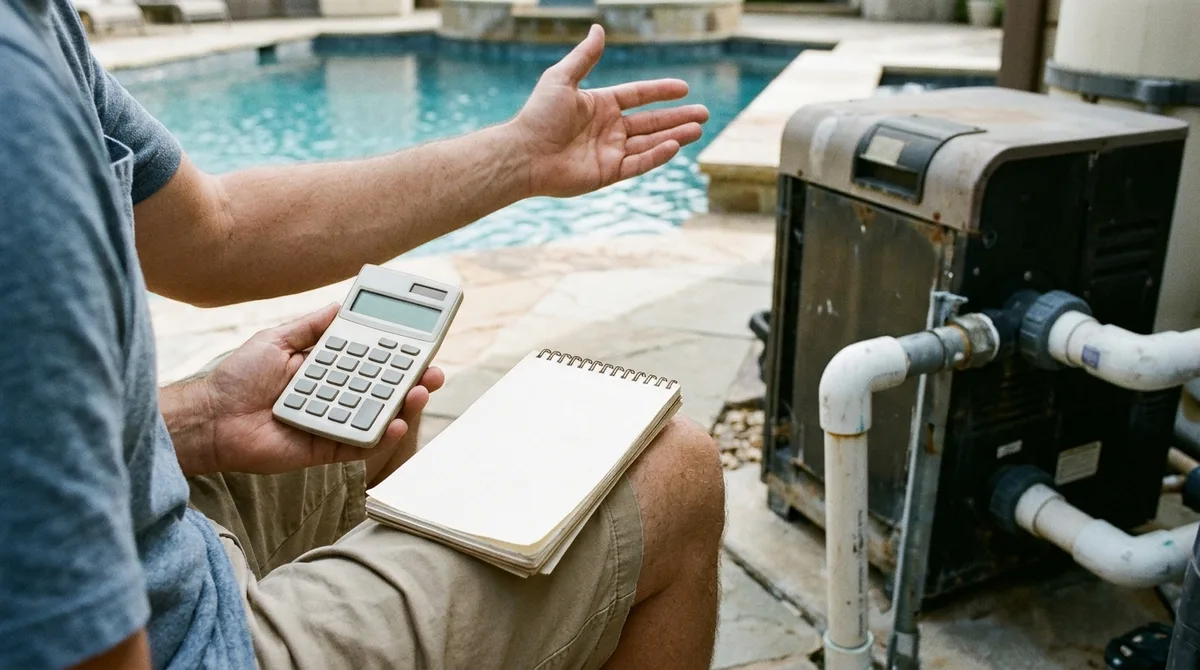
Estimate your monthly bill by matching your pool’s heating needs with local energy prices and the heater’s efficiency or performance information. Use the same assumptions for pool, weather, temperature, cover, and heating schedule for every option you compare:
- Gather your pool’s dimensions and average depth, or its volume, so each estimate uses the same amount of water.
- Set the desired water temperature and note the starting temperature and typical weather during the months you expect to swim.
- Record whether you plan to use a cover and how often and when you expect the heater to run.
- Use your actual local electricity or fuel price, along with the heater’s relevant efficiency or performance rating.
- Run the same scenario for each heater type to compare estimated monthly energy costs on an equal basis.
The modeled calculator example used a 16-by-32-foot pool averaging 5 feet deep, a 15°F initial heat-up, and 3°F of daily heat loss over 30 days. With electricity at $0.173 per kilowatt-hour and gas at $2.55 per therm, it estimated $146 for a heat pump at COP 5.0 and $437 for a gas heater at 84% efficiency. Those results apply to the example’s pool, conditions, rates, and equipment assumptions. Changing any of them can change the estimate. A calculator output is only as useful as its inputs. Check that the rates and performance details match the options you are considering, and ask a pool professional to help interpret equipment ratings if needed. A one-month estimate may not represent your entire swimming season because weather, heating schedules, and energy use can differ from month to month.
Ways to Lower Pool Heating Costs
A pool cover can help reduce heat loss. The U.S. Department of Energy says a cover can save up to 50–70% of overall pool-heater energy use. This is a potential energy saving, not a guaranteed reduction of the same size on every bill. Results depend on pool conditions and how consistently the cover is used.
Cover the pool when it is not in use to help limit heat loss. When comparing heater costs, use the same assumptions for each option, including:
- Cover use: Include whether the pool will be covered between swims.
- Heating schedule: Estimate when the heater will run and whether you need the pool warm every day or mainly before planned use.
- Target temperature: Compare costs at the water temperature you want, rather than assuming every option will maintain the same setting.
For a new pool, account for cover handling in the layout. Leave room to remove, fold, or store it, and consider how the pool’s position relates to the outdoor areas you use. These details can make regular cover use easier and help avoid paying to maintain your preferred temperature when no one is swimming.
All County Pools and Spa Inc. is a Los Angeles-based contractor with over 20 years of industry experience in complete pool installation, remodeling, and resurfacing. Its outdoor-living work includes space-saving plunge-pool design, custom hardscaping, patio covers, fire pits, and outdoor kitchens. Planning the pool and surrounding space together can help balance swimming, entertaining, circulation, and the practical routines of pool ownership.
What Should Buyers Compare Before Installing?
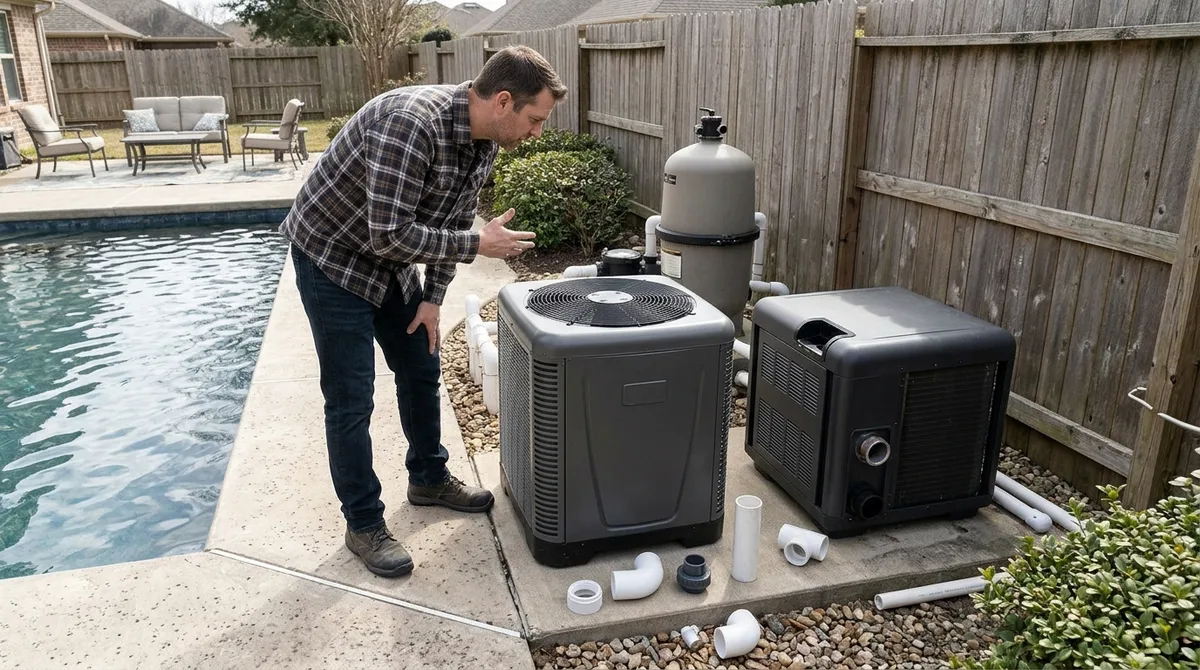
Compare heater ratings with test conditions, local energy prices, your expected swimming schedule, and your pool design. A rating alone cannot predict your monthly bill. Standardized ratings help you compare equipment, but the test conditions may differ from those at your pool.
The U.S. Department of Energy’s prescribed heat-pump test condition is 80.6°F dry-bulb and 71.2°F wet-bulb. Treat a rating at that condition as a comparison point, not a direct forecast of your monthly bill, because outdoor conditions during operation can differ. 10 CFR Part 430 Appendix P sets out the test procedure.
Gas-fired pool heaters manufactured from April 16, 2013, until May 30, 2028, must meet an 82% minimum thermal efficiency. The current regulation establishes a new integrated thermal-efficiency standard for gas-fired and electric pool heaters manufactured on or after May 30, 2028. When comparing options, check the standard that applies to the heater’s manufacturing date as well as its performance information.
Your pool plan also shapes the equipment decision. A space-saving plunge pool, for example, calls for a different backyard layout than a pool planned alongside custom hardscaping, a patio cover, fire pit, or outdoor kitchen. All County Pools and Spa Inc. is a Los Angeles-based pool installation, remodeling, and resurfacing contractor with over 20 years of industry experience, offering integrated backyard design and construction.
Plan Around Your Pool’s Lifetime Costs
Before choosing a heater, prepare a project brief with your pool dimensions or volume, preferred water temperature, expected swimming months, heating schedule, local energy rate, cover plan, and the models you are considering. Ask for each model’s heating capacity and efficiency rating, including the test basis. ANSI/ASHRAE Standard 146-2020 provides test methods for rating pool-heater capacity and efficiency across gas, oil, electric, heat-pump, and hybrid equipment. ANSI/ASHRAE Standard 146-2020 can help you compare the information consistently.
For a new pool or remodel, consider the heater alongside the overall backyard plan. A space-saving plunge pool, custom hardscaping, a patio cover, fire pit, or outdoor kitchen can all affect how you want the space to function. Sharing your project scope with a contractor can help align pool design and construction with your priorities for swimming and outdoor living.
All County Pools and Spa Inc. serves greater Los Angeles with pool installation, remodeling, and resurfacing, as well as integrated backyard design and construction. Contact All County Pools and Spa Inc. or explore Backyard Remodel Services in Los Angeles to discuss your project.
Frequently Asked Questions
1. How much does it cost to install an electric pool heater?
The installation price depends on the heater’s capacity, your pool’s plumbing, and whether the electrical service needs changes. Ask for an itemized quote covering the equipment, installation, and any required electrical work.
1. How long will it take to heat a pool?
A pool’s heat-up time depends on the heater’s output, the starting and target water temperatures, weather, and heat loss. Pool volume alone is not enough to provide a reliable estimate. The heater needs to be sized for the pool and its conditions.
3. Can you add a heater to an existing inground pool?
Yes, many existing inground pools can be fitted with a heater, but compatibility depends on the plumbing, available electrical or gas service, equipment location, and heater type. A pool professional can assess the setup before you choose and connect a unit.
4. Does a pool heater use more energy when first heating the water?
Yes, bringing cool pool water up to the target temperature requires more energy than replacing ongoing heat loss to maintain that temperature. Initial demand depends on pool volume, the temperature increase, weather, and cover use.
5. How does a pool heater work?
A pool heater warms water as the pool’s circulation system moves it through the equipment and back into the pool. Gas heaters use a fuel-fired heat exchanger, while heat pumps transfer heat from the surrounding air into the water.