
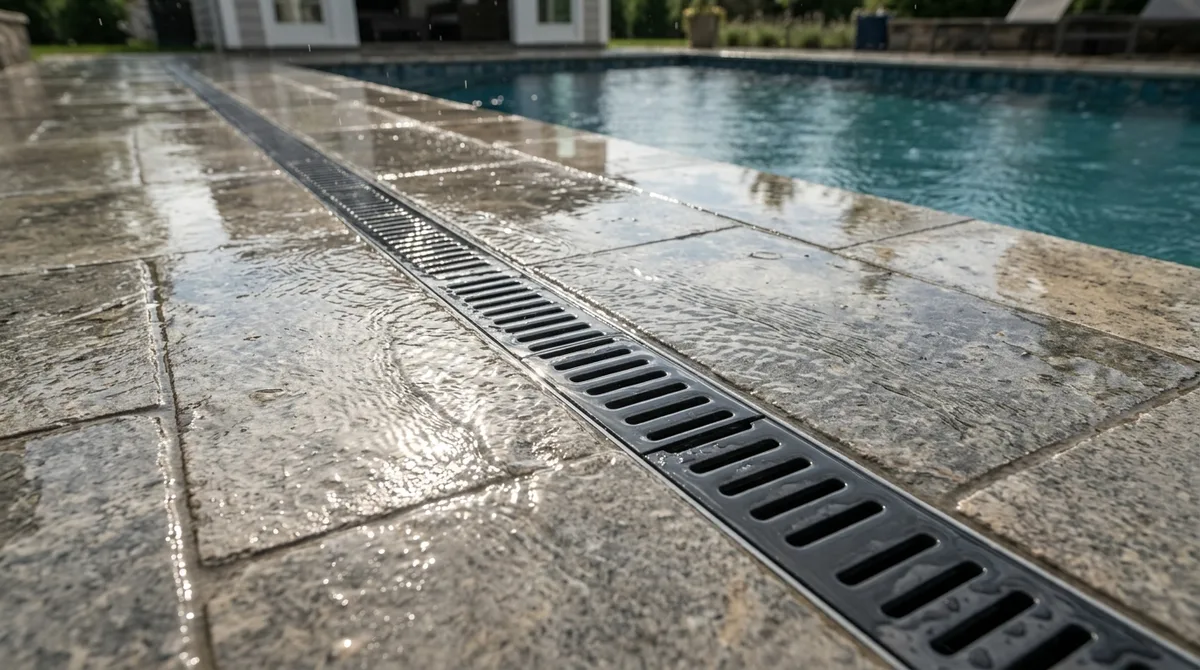
Pool deck drainage systems move runoff off the deck through properly placed drains and a sloped surface. For public pools, California code calls for a 1%–2% slope away from the pool and toward deck drainage. It also requires a finish that prevents standing water. This standard should not be assumed to apply to every private residential pool. California Building Code Section 3114B.3
In Los Angeles, the discharge route matters as much as the drain type. LADBS guidance says pool decks must not drain to the sanitary sewer and describes directing deck drainage toward the street storm drain through a non-erosive device. A drain can collect water, but it will not solve a poor outlet or a deck that slopes in the wrong direction. Identify where the water will go before choosing a repair.
Key Takeaways
- Pool-deck troubleshooting should trace runoff from its first pooling point to the outlet, because the water pattern helps locate the failure.
- Choose a linear channel drain for a long flow path or a point drain for a defined low spot.
- A localized pool-deck drain repair cannot correct settled concrete or a reversed grade.
- A pool-drainage renovation proposal should explain how runoff reaches a feasible outlet before specifying construction work.
Why Do Pool Decks Flood?
A pool deck floods when its surface does not guide runoff into clear drains and through an outlet that can carry the water away. Common causes include an insufficient or reversed slope, blocked or undersized drains, settled deck areas that create low spots, and an outlet that cannot move water away quickly enough.
Recurring ponding, water running toward the pool or house, erosion near the deck edge, and damp or stained transitions between the deck and nearby surfaces can all indicate inadequate drainage. The pattern helps narrow down the cause. Water pooling around a grate may indicate a blockage or a drain that cannot handle the flow, while water collecting in a depression away from the grate may point to settled concrete or poor grading.
If the drain is clear but water remains in the channel or backs up toward the deck, the outlet may be restricting flow. Water arriving from an adjacent patio or other hardscape can also overwhelm a deck drain, even when the drain itself is functioning. A new drain may not solve a settled deck or runoff entering from elsewhere.
Trace the water from its source to its destination before choosing a repair. Watch where runoff first gathers, whether it reaches the drain, and whether it continues through the outlet. A pool circulation drain and a pool deck drain are not interchangeable. The circulation drain is part of the pool’s water system, while the deck drain collects surface runoff.
Channel, Trench, Surface, And French Drains
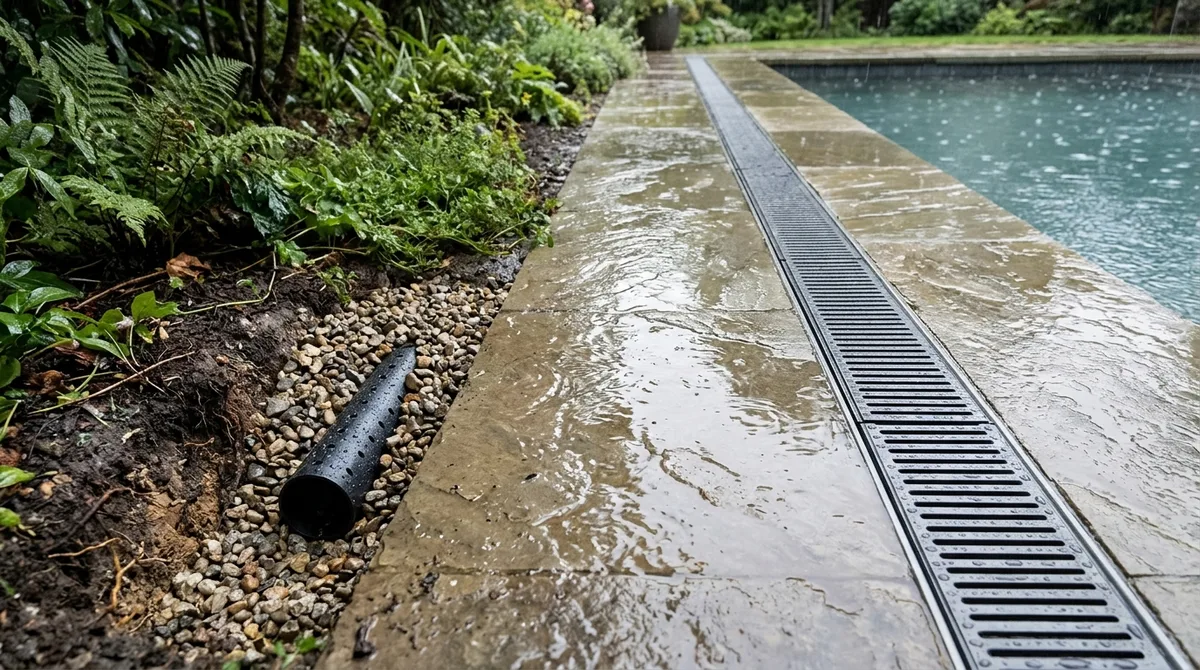
Channel and trench drains are linear inlets that collect water along a narrow run. A channel drain often refers to a formed channel covered by a grate, while “trench drain” may describe the installed system. Proposals can use the terms differently. Either type may sit across a runoff path or along a deck edge, depending on where water travels. Grate openings and material, channel capacity, and access for clearing debris affect how well a system suits the site.
Surface drains, also called point drains, collect water at a localized low spot rather than along a line. The surrounding deck must guide runoff toward the inlet, so a point drain may not capture water that flows past it or gathers elsewhere. A point drain can suit a defined low area, but the proposal should show how the deck surface directs water to it.
A French drain handles subsurface water through a buried, permeable trench, commonly using gravel and a perforated pipe to collect water below grade. It can help manage groundwater or seepage, but it is not a substitute for a surface inlet when rain or wash water must be captured from the deck. A French drain also needs a workable route for the collected water.
Compare proposals by the amount and direction of runoff, available depth, maintenance access, deck finish, and feasible outlet, not by grate appearance alone. A long flow path may favor a linear inlet, while a discrete low spot may suit a point drain. Limited depth, paving or concrete details, and the location of an acceptable discharge route can affect which system is practical. A design that collects water efficiently still needs an outlet that can receive it.
Drain Placement, Slope, And Runoff Sizing
A grading plan should show where runoff travels across the deck and where it enters a drain. Inlets belong at planned low points or across a predictable flow path, not simply wherever a grate is easiest to install. Their locations should also be coordinated with pool coping, steps, gates, and changes in deck level so those features do not interrupt the slope or leave water trapped beside them.
At a deck-to-patio transition, the designer should establish whether the patio sheds water toward the pool deck, away from it, or into a separate collection point. If runoff from both surfaces reaches the same inlet, the contributing area includes both. A change in paving or concrete finish can also affect how quickly water runs off, so the drainage plan should account for each surface rather than treating the deck as an isolated rectangle.
Drain sizing depends on the contributing area, surface materials, expected water flow, pipe route, and outlet capacity. A small inlet may be overwhelmed when a broad patio drains toward it. A larger inlet will not fix a pipe route or outlet that cannot carry the collected water away. The plan should connect the surface grading, inlet locations, and downstream route as one system.
For public pools, deck surfaces are required to slope 1%–2% away from the pool and toward deck drainage, with a finished surface that prevents standing water. That public-pool provision should not be treated as an automatic requirement for every private residential pool. The 2025 California Building Standards Code took effect statewide on January 1, 2026. Projects seeking permits from that date are subject to that edition. Confirm the requirements for a specific project with its authority having jurisdiction using the California Building Standards Commission’s code information.
Where Can Pool Deck Water Go?
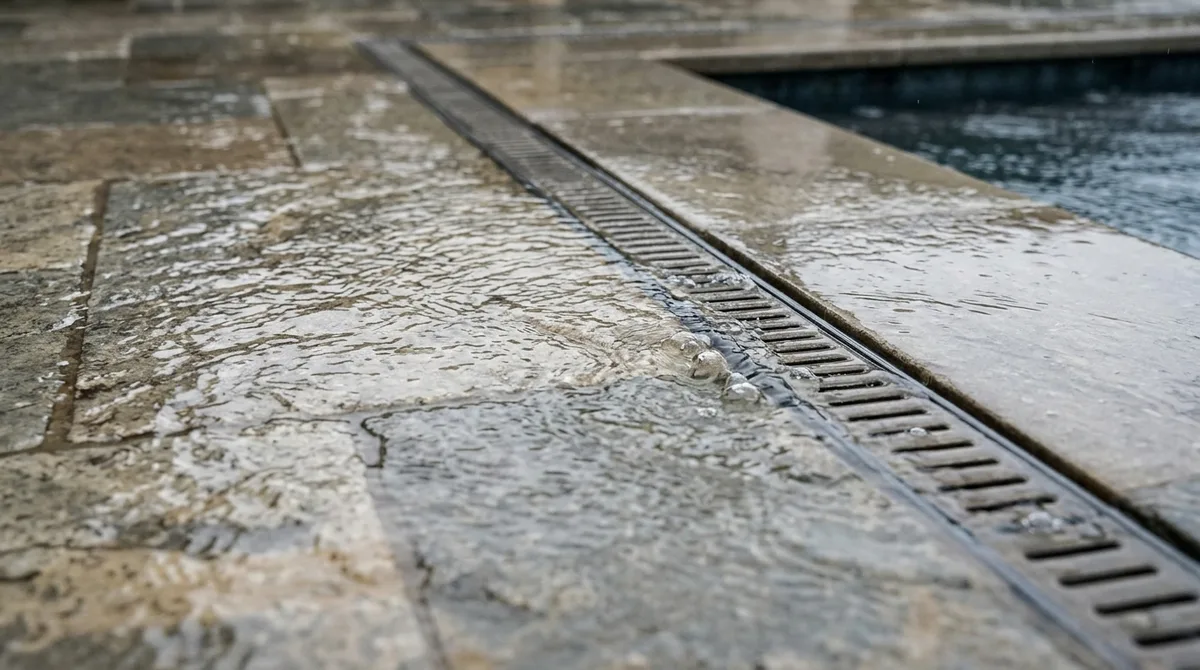
Pool-deck water should reach a safe, approved destination without ponding, eroding soil, or flowing onto neighboring property. The drainage plan needs to show the route beyond the deck to its outlet. An inlet and pipe are only part of that route. The proposed discharge point can determine whether the design is feasible and whether permits or additional work are needed.
For properties in the City of Los Angeles, pool-deck drainage must not enter the sanitary sewer. Deck drainage may be directed toward the street storm drain through a non-erosive device. Connecting to the City storm-drain system requires a Storm Drain Connection Permit under Los Angeles Municipal Code Section 64.12. The proposed route and the type of water being discharged both matter, not just the drain selected.
Residential permit requirements depend on the project’s location and scope. A route that appears straightforward on a deck plan may need a different outlet or added erosion protection after the downstream path and local requirements are reviewed. Non-stormwater discharges to the City storm-drain system are restricted unless authorized, exempt, conditionally exempt, or granted a waiver under Los Angeles Municipal Code Section 64.70.03. A licensed contractor can help coordinate permitting for residential and commercial pool projects.
Public-pool renovations have a separate county review process. The Los Angeles County Department of Public Health’s renovation requirements call for written plan approval before work begins and before building, plumbing, or electrical permits are issued. Public-pool plan approvals remain valid for two years. A drainage change on a public-pool project should be included in the plans submitted for review, rather than treated as a detail to resolve after construction starts.
Repairing Or Replacing An Existing Pool Deck
Inspect the deck before choosing between a localized repair and a broader renovation. Look for cracked or separated joints beside drains, damaged or loose grates, channels blocked by debris, settled concrete, and cracks that interrupt the intended path of surface water. Note where water collects after it reaches the deck, not just where it first appears. A visible defect may be near the symptom rather than the cause.
Adding a channel drain to an existing deck can involve cutting concrete, connecting piping, and restoring the surrounding surface. Before committing to the cut, confirm that the pipe can reach a workable, approved outlet. If the route or outlet cannot be resolved, a new channel may collect water without providing a practical way to carry it away.
A targeted repair may suit a damaged grate, a localized blockage, or a separated drain joint when the surrounding deck remains stable and directs water toward the inlet. Replacing a grate or sealing a joint will not correct settled concrete or a reversed grade. Check whether the support beneath the deck and the surface slope also need attention. Otherwise, water may continue to pond or bypass the repaired drain.
Broader deck work may be more appropriate when settlement or cracking is widespread, transitions are uneven, or the existing drainage layout cannot be made workable with isolated repairs. Depending on the conditions, the remedy may involve replacing part of the deck or regrading a larger area. Coordinate the drain height and deck edges where the surface meets patios, coping, steps, or other hardscape. A repair that leaves one edge too high or too low can create a new ponding spot or send runoff into an adjacent area.
What Should A Drainage Renovation Include?
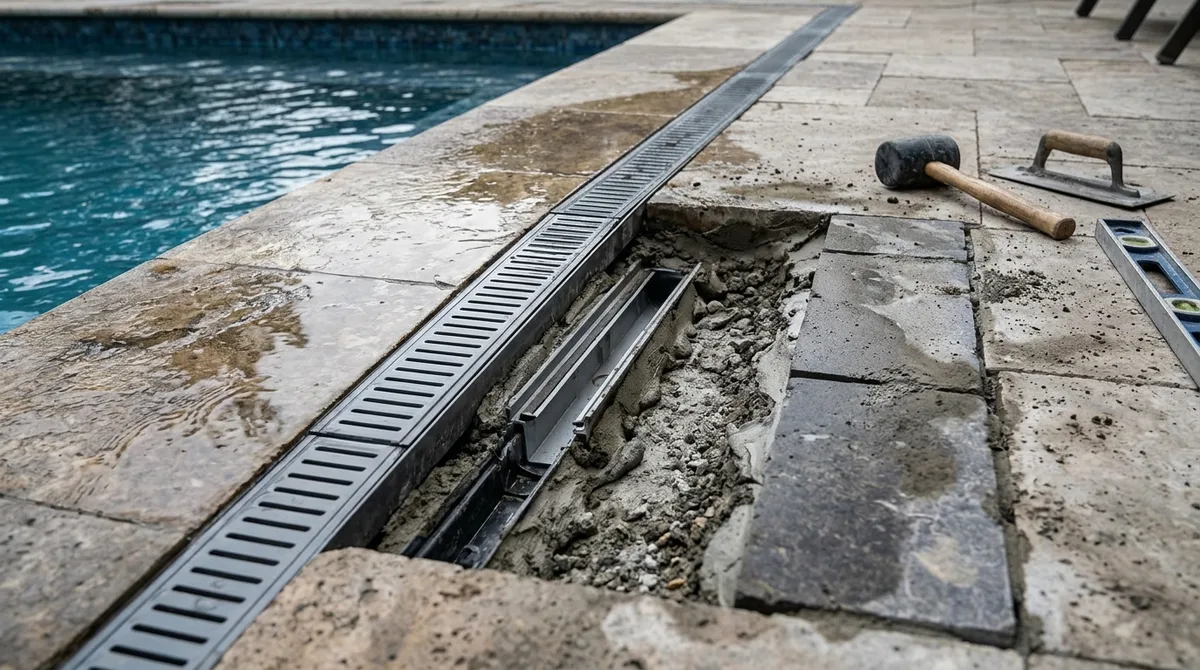
A drainage-renovation proposal should trace the water problem from its source through collection to a feasible discharge point, then identify the construction needed to make that route work. It should describe the drainage diagnosis, inlet type and placement, grading changes, pipe route, discharge point, deck demolition and restoration, and any permit or coordination needs.
Scope can grow when runoff comes from a larger patio or yard area, the outlet route is difficult, or concrete must be removed and restored. Repairs may also need to address settled deck areas and uneven transitions that trap or redirect water. An itemized estimate can show how drainage work fits into a broader pool or backyard renovation.
As a historical Los Angeles-area market benchmark, a Q1 2025 estimate for installing a 50-linear-foot channel drain was $2,800–$4,200. That figure is not an official rate or a quote for a particular project. Actual scope and cost depend on the site, drainage route, demolition, and restoration required.
Plan Drainage Before The Deck Goes In
Before requesting bids, prepare a site sketch showing the pool, deck and patio edges, existing drains, places where water collects, and the possible route to an outlet. Add photos of ponding or erosion after rain, and note whether runoff from a patio or another hardscape also reaches the deck. Ask the contractor to identify which parts of the drainage route need repair and which need redesign.
For a public-pool renovation, include drainage changes in the plan-review scope and account for the review and inspection steps. Los Angeles County says plan review includes an initial review and one revised-plan review, while inspection fees may include a final inspection and one final reinspection, as described in its pool plan-check information.
A City of Los Angeles project involving grading exceeding 200 cubic yards may also need schedule planning around the grading-code rainy season, October 1 through April 15. During that period, work cannot begin until an erosion-control system is approved and the City is satisfied that the work will not endanger people, property, or public welfare, under Los Angeles Municipal Code Section 91.7006.
A licensed contractor serving Tarzana and communities across greater Los Angeles can discuss your drainage renovation.
Frequently Asked Questions
1. How often should pool deck drains be cleaned?
Clean pool deck drains when leaves, dirt, or other debris begin to restrict flow, and inspect them after storms or heavy leaf fall. The right interval depends on nearby trees, wind exposure, and how much debris reaches the deck.
2. How do you remove a pool deck drain cover safely?
To remove a pool deck drain cover safely, first check how it is secured and use the appropriate tool to release its fasteners. Wear gloves and lift the cover without forcing it. If it is stuck, damaged, or too heavy to handle safely, have a qualified contractor remove it.
3. Can a pool deck drain connect to a rainwater collection system?
A pool deck drain can connect to a rainwater collection system if that system is designed to accept the runoff and has a safe overflow route. Confirm that the connection and any overflow comply with local discharge requirements before installation.